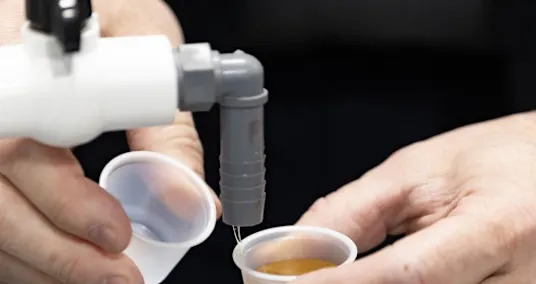
An investigation by Canada’s national broadcaster has found that a major Quebec producer has been diluting its maple syrup with cane sugar and selling the fraudulent product to grocery chains.
In a sting operation that involved false identities and covert recordings, journalists from Radio-Canada’s Enquête programme found that a low-cost syrup sold in major grocery store chains was heavily diluted.
Samples of the brand, which is sold in hundreds of locations across Quebec, were sent to the province’s research and testing facility, Le Centre ACER.
Related: Air Canada CEO to resign after backlash to video tribute of pilots killed in crash
“This is the first time I’ve seen falsification of this kind. You can see that it’s outright cane sugar that’s been added to the cans,” Luc Lagacé, a microbiologist and the director of research at ACER, told Enquête. “This is not an accident. It’s deliberate.”
Maple syrup is a dominant industry in Quebec, where decades of technological innovation and investment helped farmers harvest 239m pounds of it last year. The Francophone province is responsible for nearly all of Canada’s production and nearly three-quarters of global production. A barrel of syrup is worth nearly C$1,000.
The industry is worth nearly C$1bn annually and the immense value of the market has lured criminal elements to Quebec’s global strategic reserve of syrup.
In 2011, thieves slowly siphoned off maple syrup worth nearly C$18m from the stockpile, a heist that led to 40 arrests and jail sentences for five men.
The investigation into the fraudulent syrup began when a reporter at CBC’s Radio Canada discovered an odd taste to the syrup he had bought. The can was labelled “pure maple syrup” and linked to a producer south-west of Montreal, Steve Bourdeau.
Enquête had two people pose as buyers for a grocery store to reach out to Bourdeau.
The journalists taped telephone conversations and later used a hidden camera to capture footage of Bourdeau. He told the reporters he knew it was illegal to cut maple syrup labelled as pure with other sugars – and said that he didn’t do that.
Bourdeau’s syrup is sold by major grocery chains, including IGA and Metro.
“I’m the best when it comes to prices. The others can’t even come close,” he said, adding his maple syrup cost less than C$5 a can. “There’s a lot of jealousy going on. Because I have the market. And it’s not entirely legal. And I got away with it anyway.”
When Bourdeau was confronted with the findings from the lab tests, he initially denied the allegations before suggesting a supplier from outside the province was to blame.
He told reporters he was launching his own investigation to try to determine how cane sugar had been mixed in with his product and would implement his own inspection system.
The head of Quebec’s sprawling stockpile of syrup told CBC that using suppliers from outside the province was not illegal – but falsely labelling such syrup as having Quebecois origins was.
Geneviève Clermont, head of ACER’s inspection division, said 90% of syrup from Quebec sold in bulk was tested, but she said that products canned and sold by producers themselves were not inspected regularly.
Many of the popular maple-flavoured syrups sold in the US are made of corn syrup (or high-fructose corn syrup) with added flavourings and caramel to give the amber-like appearance of genuine maple syrup.
Producing maple syrup, which can only occur during a narrow window of time in the spring, requires immense volumes of sap, which is then boiled down into the final product.
latest_posts
- 1
 The Meaning of Breaking the Pen's Nib in Death penalties
 - 2Don't miss these five impressive spots in Bangkok
- 3Flights canceled at 40 U.S. airports: Follow live updates as FAA cuts to air traffic take effect amid government shutdown
- 4Record-breaking flu hospitalizations in New York in a single week: Health officials
- 5Vote in favor of Your #1 sort of pie




- Fetterman says he's back home after a fall put the Pennsylvania senator in the hospital
- German gas price bill signed into law, but consumers not impressed
- Ukraine apologizes to Finland for crashed drones
- Explainer-What will change with the US reclassification of marijuana?
- Volkswagen in talks with defence firms on use of Germany plant: CEO
- Putting pig organs in people is OK in the US, but growing human organs in pigs is not – why is that?
- PFAS in pregnant women’s drinking water puts their babies at higher risk, study finds
- See as Your #1: These Low-Sugar Food sources You Ought to Attempt
- The most effective method to Quick Track Your Outcome in Advanced Showcasing with a Web-based Degree